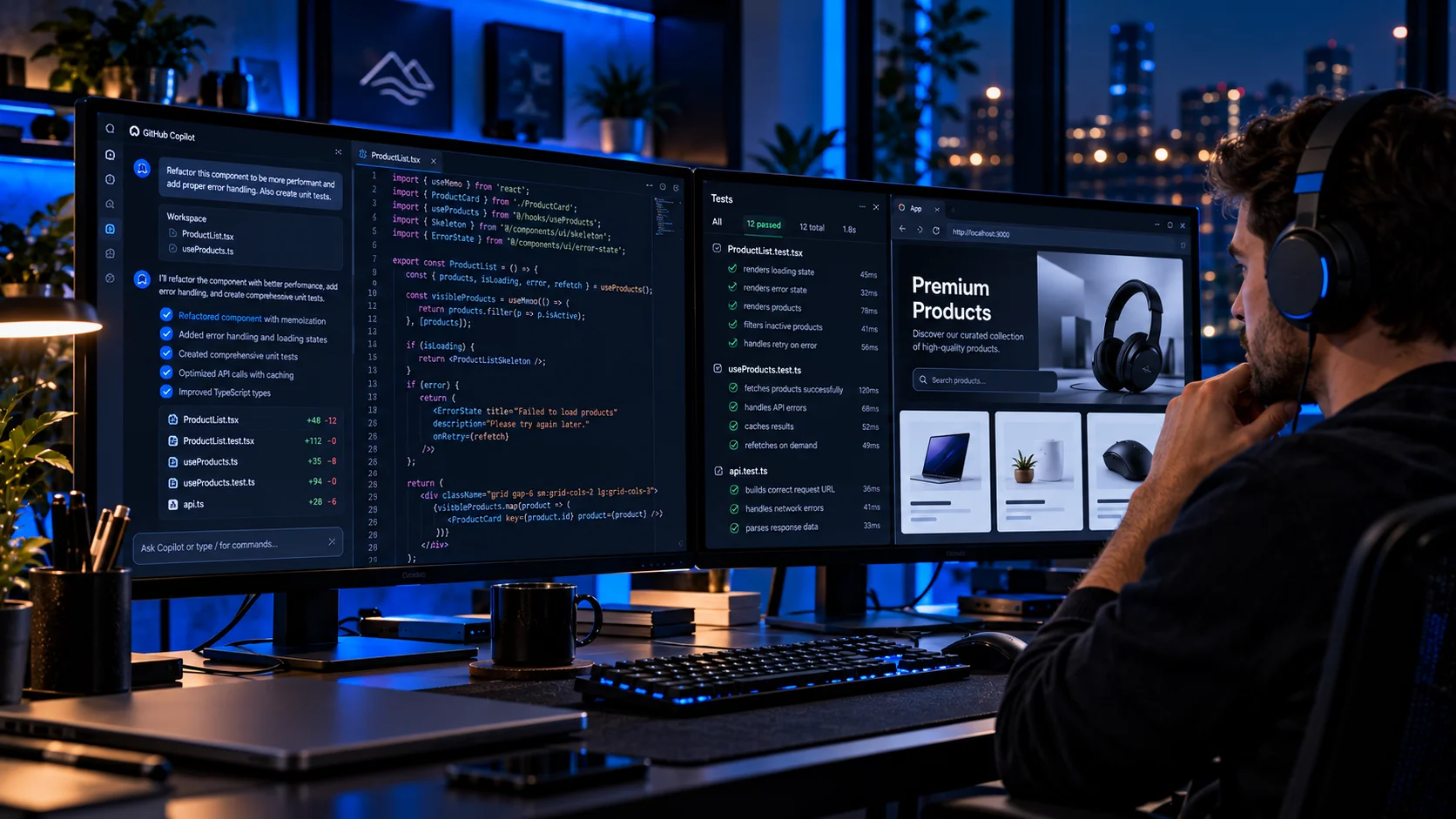
Vibecoding is a way of building software in which you describe to an AI model what you want to build, and it generates the code. The term appeared in February 2025 in a post by Andrej Karpathy, and in November 2025 the Collins dictionary chose “vibe coding” as its word of the year. For companies commissioning software, what matters is not how the name sounds, but what it changes in time, cost and risk.
In short
- Vibecoding shortens the time to build prototypes and application skeletons.
- It does not replace the programmer: someone has to design, review code and answer for security.
- The biggest risk is code shipped without verification.
- For the client, the outcome is what counts: faster and cheaper at the start, but with quality control.
How it works in practice
Traditionally, a programmer writes code line by line, knowing the syntax, libraries and patterns. In vibecoding they describe the intent, for example “a contact form with email validation, sending data through an API to the backend and saving it in PostgreSQL”. The AI generates a proposal, and the programmer reads it, runs it, tests it and fixes it.
Description
The programmer states the goal and constraints, not individual lines.
Generation
The model proposes code, file structure and tests.
Review
A human reads, runs and verifies the logic and security.
Iteration
Fixes, tests and further features, up to the production version.
Are programmers becoming redundant
No. Their role is changing: it looks more like an architect than a bricklayer. A good programmer working with AI must understand the system architecture, judge the quality of the generated code and know when the model is wrong. AI can confidently generate code that looks correct but has a logic error or a security hole.
Risk: code without review
Generated code must be read, tested and checked for security (user data, permissions, dependencies). An app built "by feel" and shipped without verification is a longer-term cost, not a saving.
Where vibecoding helps the most
- prototypes and working mockups that let you quickly test an idea,
- application skeletons: login, roles, dashboards, forms,
- websites and landing pages,
- repetitive tasks: migrations, tests, documentation,
- automations and integrations between systems.
At Mikamait we use this technique as one of our working tools: the project skeleton comes together faster, and we spend the time on business logic, testing and security. We work this way, among other things, on web applications for business and subscription products, described in the article from a business card website to SaaS.
Prototype in a few days
Let's test your idea on a working prototype
Describe what the app should do, and we will outline the scope of the first version and an indicative timeline.
Describe your idea+48 731 377 999What this changes for companies commissioning software
The technology shortens the skeleton stage, so for simple projects timelines can be counted in days and weeks, not months. The need for analysis, design, testing and maintenance does not disappear, however. When choosing a contractor, ask who reviews the code, what testing looks like, who owns the code and what happens after launch. We describe practical selection criteria in the article how to choose an IT company.
You can check the prices of our services in the price list, and read about the team in the about us section. We always agree a fixed price and scope before we start.
Need help?
Build software faster, with quality control
We combine software engineering with AI tools, delivering finished projects in days or weeks instead of months. We reply within 24 hours.
Write to us (reply within 24 h)Call: +48 731 377 999