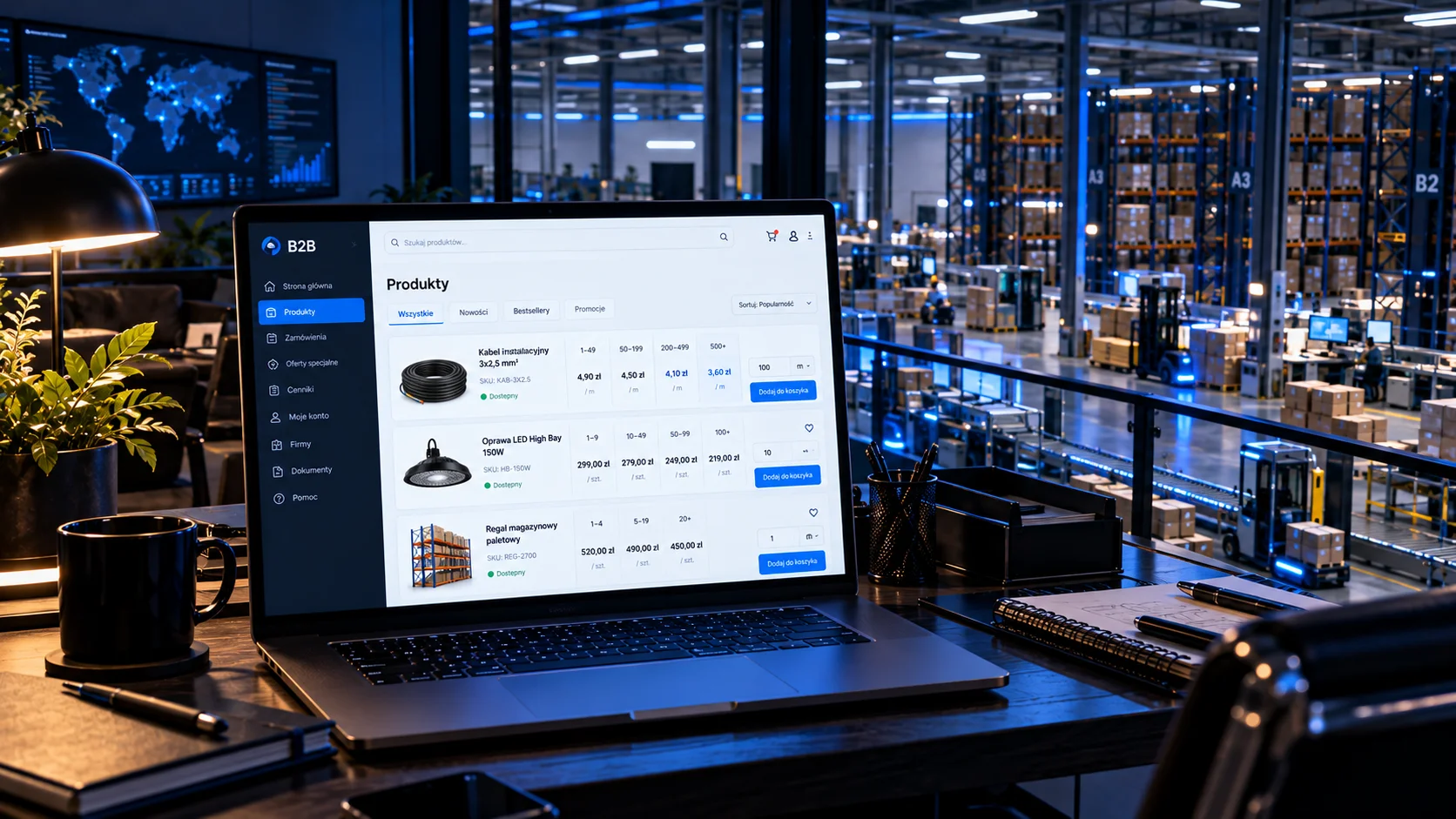
Wholesaler customers today expect to order online, track status and access price lists without calling a sales rep. The solution is a B2B platform: a system in which a logged-in business partner sees what matters to them, and the order goes straight to the warehouse and the ERP.
In short
- A B2B platform is not a store with higher prices: prices, limits and availability are individual for each business partner.
- The core of the value is ERP integration: stock, prices and orders without manual re-typing.
- From 2026 invoicing goes through KSeF, so plan for it from the start.
- Calculate the cost model (custom platform or subscription) over a 3-5 year horizon.
A B2B platform vs an online store
B2B platform
- Access after login, company accounts with roles
- Individual prices, discounts and limits
- Minimum quantities, bulk packaging, quick order from a file
- ERP data in near real time
Online store (B2C)
- Public price list for everyone
- Online payment at checkout
- A simple cart for a single customer
- Usually a simplified warehouse integration
If you sell to both retailers and end customers, consider both channels on one back end. We compared sales channels in the article own store or Allegro (Allegro is Poland’s largest marketplace).
What a B2B platform should include
| Module | What it does |
|---|---|
| Catalog | Filters, search, product photos and parameters |
| Price lists | Discounts and individual prices per business partner or group |
| Cart | Validation of minimums, packaging multiples, order import from a file |
| Partner account | Order history, documents, balance, credit limit |
| Admin panel | Management of prices, business partners, availability and statuses |
| Notifications | Emails about order status and exceptions |
At Mikamait we have built such platforms for companies from different industries, from electrical equipment manufacturers to building material distributors. Each platform looks different because processes in a wholesaler differ, but the core is shared. You can find more about the solution on the page B2B platform for wholesale trade.
ERP integration: the heart of the project
A platform without integration is just another panel for manual re-typing. Value appears when data flows on its own:
The ERP synchronizes products and stock
The platform shows current availability and prices from Subiekt, Comarch, Symfonia or a custom system.
The business partner places an order
The system validates the minimum, the credit limit and availability before approval.
The order goes to the ERP
An order document is created, the warehouse receives the task, and the sales rep sees it in their own system.
The status returns to the customer
The business partner sees fulfilment progress and, once the invoice is issued, finds it in the panel.
We described the technical details of connecting a store with trading programs in the article B2B, Symfonia and store-ERP integration and on the integrations page.
Free consultation
We will check whether your ERP can be connected to a B2B platform
We will see what APIs or databases your program exposes and tell you what can be automated in the first stage.
Book a call+48 731 377 999Invoicing and KSeF
A B2B platform sits at the crossroads of orders and invoices, so it must fit the new e-invoicing rules. According to the official KSeF portal, the obligation to issue invoices in KSeF started on 1 February 2026 for companies with sales above PLN 200 million in 2024, and from 1 April 2026 it covers all other taxpayers.
Receiving invoices is also your obligation
Even if your invoices are issued by the ERP, a wholesaler buys goods from other companies. Purchase invoices will arrive in KSeF, so decide who downloads them and how they reach the warehouse. We described deadlines and fallback modes in the article KSeF from 2026, and you can find the integration service on the page KSeF invoice automation.
Rollout in stages
The safest approach is to start with the smallest useful scope: partner login, a catalog with individual prices and order placing with handover to the ERP. Only then add credit limits, order import from a file, notifications and documents. This way your first customers use the platform after a few weeks, and you collect feedback before expanding. A similar development logic is described in the article from a business card website to a SaaS platform.
Costs: custom platform or subscription
Ready-made B2B platforms (SaaS) have a monthly fee depending on the plan, number of products and users, which usually means a cost that grows with sales. A dedicated platform is a one-off investment with no licence fees, but maintenance and development costs are added. To compare both models fairly:
- Calculate the subscription cost over a 3-5 year horizon, including surcharges for integrations.
- Check the limits: products, users, orders, API.
- Ask about rights to the code and the possibility of migrating data.
- Add hosting, backups and support for a dedicated platform.
Indicative amounts are in the price list, and we prepare a platform quote after analysing your processes. For companies in the region this is a chance to level the playing field with big players: a local wholesaler with a good platform can serve customers from all over Poland.
Need help?
Digitalising B2B wholesale sales
Individual price lists for business partners, trade credit limit handling and ERP integration. Increase your sales volume in wholesale trade. We reply within 24 hours.
Write to us (reply within 24 h)Call: +48 731 377 999