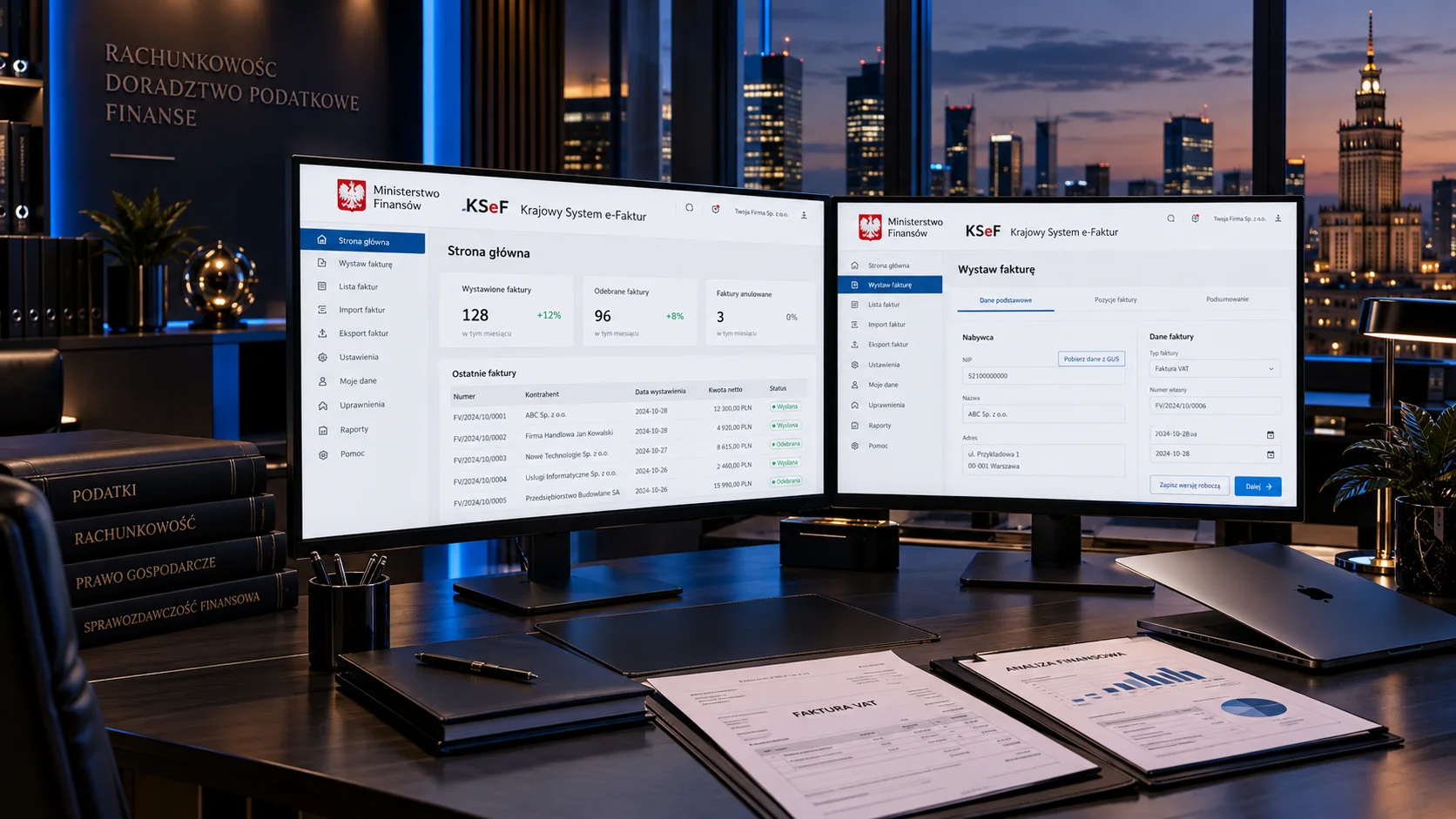
KSeF (Krajowy System e-Faktur, Poland’s National e-Invoicing System) is no longer just an announcement. Since 1 February 2026 every company receives invoices in it, and since 1 April 2026 most companies must issue invoices in it. For a shop in Szczecinek, a workshop in Barwice, a construction company from Borne Sulinowo or a haulier from Czaplinek, the question today is different from a year ago: not “whether”, but “what is left to close before 1 January 2027”.
This article describes the legal position as of 22 October 2026: who is covered and from when, what the exceptions are, how offline modes and QR codes work, what the penalties are, and what the government draft of 20 October 2026 changes. At the end you will find a 7-day plan and a checklist.
In short
- KSeF applies from 1.02.2026 (sales above PLN 200 million in 2024) and from 1.04.2026 (everyone else). Receiving invoices through KSeF applies to everyone from 1.02.2026.
- Until 31.12.2026 the following can stay outside KSeF: companies with invoices up to PLN 10,000 gross per month, and invoices from cash registers (including receipts with a NIP up to PLN 450). From 1.01.2027 this ends.
- Penalties under Art. 106ni: up to 100% of the invoice VAT or 18.7% of the gross amount. The law says 1.01.2027; the government draft of 20.10.2026 moves them to 1.01.2028 - not yet enacted.
- Invoices for consumers and invoices from foreign suppliers do not have to go through KSeF.
- For 2027 prepare: a KSeF certificate (tokens formally until 31.12.2026), a type 2 certificate for offline mode, and the KSeF number in the title of transfers between businesses.
KSeF timeline: key dates 2026-2028
The basis is the Act of 5 August 2025 amending the VAT Act (Journal of Laws 2025, item 1203) and regulations of the Minister of Finance and Economy from December 2025 (including Journal of Laws 2025, item 1740 on exclusions and item 1800 on JPK_VAT). The stage dates are confirmed by the official page KSeF implementation stages.
Module for notifying invoices with attachments in e-US
The ZGL_ZAL form for companies that want to send invoices with an attachment.
KSeF 2.0 launches, obligation for the largest companies
Issuing is mandatory for companies with sales above PLN 200 million gross in 2024. Every company receives invoices through KSeF. New markings in the JPK_VAT from the February settlement.
Obligation for everyone else
SMEs, sole proprietors, VAT-exempt taxpayers. Exception until the end of the year: invoices up to PLN 10,000 gross per month and invoices from cash registers.
End of transitional periods
End of the PLN 10,000 exception, of cash register invoices outside KSeF and (under current rules) of token login.
KSeF for everyone with no threshold exception
KSeF number in the transfer title between active VAT taxpayers (Art. 108g). Penalties under Art. 106ni - under the current law.
Penalties under the government draft
The draft adopted by the Council of Ministers on 20.10.2026 moves the penalties back by a year. It still has to pass the Sejm, the Senate and receive the president's signature.
Who, from when, what - table of obligations
| Who | Issuing in KSeF | Receiving in KSeF | Notes |
|---|---|---|---|
| Company with sales above PLN 200 million gross in 2024 | from 1.02.2026 | from 1.02.2026 | in the region mainly wholesalers, retail chains, energy and fuel suppliers |
| Other active VAT taxpayers (SMEs, sole proprietors) | from 1.04.2026 | from 1.02.2026 | most businesses in Szczecinek and the surrounding area |
| VAT-exempt (by entity or by object) | from 1.04.2026 | from 1.02.2026 | applies to anyone who must issue invoices |
| Invoices up to PLN 10,000 gross per month | from 1.01.2027 | from 1.02.2026 | what counts is the invoice issue date, not the sale date |
| Cash register invoices, receipts with a NIP up to PLN 450 | from 1.01.2027 | - | paper or PDF until the end of 2026 |
| Invoices for consumers | voluntary | - | you agree the delivery method with the customer |
| Invoices from foreign suppliers | - | outside KSeF | marked BFK in the JPK_VAT |
How do you calculate the PLN 10,000 limit? According to the MF, you count only invoices that would otherwise have to go through KSeF, by their value including VAT. You do not count consumer invoices, cash register invoices, receipts with a NIP up to PLN 450, or sales to private individuals documented by a cash register. If you exceed the limit in a given month, you must issue the invoice that exceeded it, and all subsequent ones, in KSeF. A drop in sales in later months changes nothing.
Mistake no. 1: "I am small, KSeF does not apply to me"
Even if you use the PLN 10,000 limit, since 1 February 2026 invoices from suppliers who are already in KSeF reach you through the system. An invoice is deemed received on the day the KSeF number is assigned - even if nobody in the company has opened it. KSeF does not send notifications, so someone (you, your software or your accounting office) must download invoices regularly.
What is happening now, in October 2026
For half a year most companies in the region have been issuing invoices in KSeF. Three things follow from MF announcements and rule changes that are worth knowing.
The system is sometimes unavailable
On ksef.podatki.gov.pl in recent weeks there have been notices about disruptions in the KSeF 2.0 Taxpayer Application (25.09.2026) and possible problems accessing invoices (13.10.2026). This is not an exceptional situation - which is exactly why offline modes are in the law. A company that has not tested issuing an offline invoice with QR codes usually discovers the missing type 2 certificate on the day of the outage.
Penalties: the law in force vs the government draft
In 2026 no financial penalties for KSeF-related violations are imposed. In its reply to interpellation no. 17163 (described by INFOR on 1.09.2026) the MF confirmed that penalties start on 1 January 2027, and reminded that penalties can be reduced (Art. 189d of the Code of Administrative Procedure) and waived in cases of force majeure.
On 20 October 2026 the Council of Ministers adopted a draft amendment to the VAT Act (UD477) that moves the start of the Art. 106ni penalties to 1 January 2028. The draft is meant to enter into force on 31 December 2026. Important caveats:
- it is still a draft - until it is enacted and published in the Journal of Laws, the binding date is 1 January 2027,
- the obligation to use KSeF does not change, and neither does the size of the penalties,
- according to pit.pl, in 2027 the KAS (National Revenue Administration) is to send reminders first and, if they are ignored, carry out verification of VAT settlements.
2027: what changes despite the postponed penalties
Even if the draft passes, 1 January 2027 remains the turning point:
- the PLN 10,000 exception disappears - every B2B invoice goes through KSeF,
- issuing cash register invoices outside KSeF ends, and simplified invoices (receipts with a NIP up to PLN 450) are to go to KSeF - a shop, a petrol station and a workshop need cash register sales linked to the invoicing software,
- a transfer for a KSeF invoice between active VAT taxpayers must contain the KSeF number (or a collective identifier) - this follows from Art. 108g of the VAT Act, confirmed by the MF FAQ for sole proprietors and SMEs; it does not apply to cards, BLIK (Polish mobile payment) and cash,
- under current rules token login ends.
KSeF in practice
Does your store, cash register or booking system not talk to KSeF?
We connect sales software and applications to the KSeF 2.0 API so that invoices go out and come back automatically.
See KSeF automation+48 731 377 999Mandatory through KSeF and exceptions
The statutory exceptions are supplemented by the MF regulation of 7 December 2025 (Journal of Laws 2025, item 1740). Most exceptions are optional - you may issue such an invoice in KSeF if that is more convenient.
Mandatory through KSeF
- invoices for companies with a Polish NIP (B2B), including advance and settlement invoices
- correcting invoices to invoices issued in KSeF
- invoices for EU and non-EU contractors issued by a Polish taxpayer (you send the customer a PDF with a QR code)
- invoices of VAT-exempt taxpayers
- self-billing, if the buyer has authorisation in KSeF
- from 1.01.2027: cash register invoices and invoices up to PLN 10,000 per month
Outside KSeF (or voluntary)
- invoices for consumers (B2C) - voluntary
- invoices for a sole proprietor buying privately - voluntary
- until 31.12.2026: cash register invoices and receipts with a NIP up to PLN 450
- passenger transport tickets and motorway tolls (receipt with a NIP)
- VAT-exempt financial and insurance services on invoices with a narrower data scope
- self-billing by a foreign buyer without a Polish NIP
- invoices received from foreign suppliers
Corrections, attachments, self-billing
- Corrections. An invoice in KSeF cannot be deleted or “cancelled”. You fix an error with a correcting invoice in KSeF - the number of corrections is not limited. A wrong buyer NIP is especially painful: the invoice goes to someone else’s company, and fixing it requires a correction and a new invoice. Agree a procedure with your accounting office before the first such case.
- Attachments. An invoice with an attachment (for example a detailed breakdown of consumption, items or routes) requires a prior ZGL_ZAL notification, filed only in the e-Urząd Skarbowy. Processing takes up to 3 business days, and the MF stipulates that the attachment may contain only tax data or data related to it - not contracts, price lists or protocols.
- Self-billing. If the recipient issues invoices on your behalf (for example a purchasing point, some transport orders), you must grant them self-billing authorisation in KSeF.
Permissions, certificates and tokens
You log in to KSeF with a Trusted Profile (Profil Zaufany), a qualified signature, a qualified seal, a token or a KSeF certificate. A PESEL number alone is not enough. The MF announced login through mObywatel (the government mobile app) from 1 April 2026 via the national node.
Who grants permissions
- Sole proprietorship - the owner logs in personally and can grant permissions to an employee or an accounting office in the KSeF Taxpayer Application.
- Company - the first permissions are granted by a person with a qualified signature or seal. If nobody on the board has such tools, a ZAW-FA notification is filed at the tax office (the template is in the regulation on using KSeF).
- An accounting office can receive permission as an entity and distribute access to its own staff itself - you do not need to grant it to each accountant separately.
Type 1 certificate, type 2 certificate and token
| Tool | Purpose | Important |
|---|---|---|
| KSeF type 1 certificate | login and authentication of programs | valid for a maximum of 2 years |
| KSeF type 2 certificate | the second QR code (“CERTYFIKAT”) on an offline invoice | without it you cannot issue a correct offline invoice to hand to a customer |
| Token | login of programs and integrations | until 31.12.2026 under the regulation; the MF proposes keeping it |
You cannot generate a single certificate for both purposes - you need two. On tokens, in its summary of the 11 June 2026 consultations the MF proposed keeping them after 31 December 2026, with a validity of 1 to 365 days and automatic renewal with the owner’s consent. As of 22 October 2026 no amended regulation has been published. We cover the technical side in the guide KSeF - certificate, token and environments.
The accounting office and your obligations
The office can issue and download invoices on your behalf, but you are responsible for an invoice issued outside KSeF. Agree in writing: who issues, who downloads cost invoices and how often, who makes sure offline invoices are sent on time, and who holds the certificates.
Offline modes, outage and QR codes
Online mode is the default: the invoice is issued at the moment KSeF accepts it and assigns a number. When the connection does not work, you have three modes described in the MF FAQ:
| Mode | When | Deadline for sending to KSeF |
|---|---|---|
| Offline24 | a problem on your side (internet, software) or by choice | no later than the next business day |
| Offline (unavailability) | KSeF unavailability announced by the MF, for example maintenance | no later than the business day after the unavailability ends |
| Emergency | a KSeF outage announced in the MF’s BIP and in the interface software | 7 business days from the end of the outage |
QR CODE I and QR CODE II
An invoice handed to a customer before being sent to KSeF (offline) must have two QR codes:
- CODE I labelled “OFFLINE” - lets the recipient verify the invoice in KSeF after it is uploaded,
- CODE II labelled “CERTYFIKAT” - confirms the issuer’s identity, generated with a KSeF type 2 certificate.
An invoice already sent to KSeF and given to the customer, for example as a PDF (consumer, foreign contractor), has one QR code with the KSeF number. You issue an offline invoice in the same FA(3) structure as an online one - a “paper invoice from Word” is not an offline invoice.
Mistake no. 2: offline without a type 2 certificate
A typical scenario: the software "has an offline mode", but the company never generated a type 2 certificate. The invoice goes out without CODE II or does not go out at all. Check this today in the KSeF Taxpayer Application, not on the day of an outage.
Cost invoices and JPK_VAT
From the February 2026 settlement (regulation Journal of Laws 2025, item 1800) every item in the JPK_VAT has one of these markings:
- KSeF number - the invoice already has a number on the day the JPK is filed (including from offline modes, if it managed to reach KSeF),
- OFF - an emergency-mode invoice without a KSeF number on the day the JPK is filed,
- BFK - a paper or electronic invoice outside KSeF (for example from a foreign supplier, or within the PLN 10,000 limit),
- DI - a document other than an invoice (for example a receipt, an internal document).
On the cost side two rules are key. First, an invoice is received on the day the KSeF number is assigned, so from that day the payment term runs and the right to deduct VAT arises. Second, invoices from foreign suppliers (Google and Meta ads, hosting, licences) still arrive by email and have to be collected separately.
Cost invoices and the warehouse
If you run a warehouse, download the XML from KSeF straight into your warehouse software and create a goods receipt (PZ) document from it. Retyping items from a PDF rendering is a waste of time and a source of stock discrepancies. This is how, among others, the integration of Subiekt with an online store works.
KSeF software: free MF tools and commercial ones
Free MF tools - the KSeF 2.0 Taxpayer Application (permissions, certificates, tokens, issuing and viewing invoices, UPO confirmations), the KSeF Mobile Application (issuing, receiving and draft invoices, available since 1 February 2026) and e-mikrofirma in the e-Urząd Skarbowy, which transfers invoices to the VAT register. For a sole proprietor with a dozen or so invoices a month this is enough.
Commercial software - Subiekt nexo and GT, Comarch ERP Optima and XL, Symfonia, inFakt, wFirma, Fakturownia and others have KSeF 2.0 modules. When choosing, do not check just “supports KSeF”, but specifically:
- whether it downloads cost invoices automatically and how often,
- whether it issues an offline invoice with CODE I and CODE II (and where it stores the type 2 certificate),
- whether it logs in with a certificate and not only a token,
- whether it carries the KSeF number into the JPK_VAT and the transfer,
- whether it connects to the cash register and the store (important from 2027).
If you sell through an online store, Allegro (Poland’s largest marketplace) or B2B, and your accounting is in Symfonia or Comarch, invoices should move between systems without manual export - see Symfonia, Comarch and Allegro integration. An example from our practice: KSeF integration with a campsite booking system.
What to do in 7 days - a plan for a small business from Szczecinek
Day 1: work out where you stand
Add up your gross B2B invoices from recent months. If you use the PLN 10,000 limit, plan your move into KSeF before 1.01.2027. Check whether you issue invoices from a cash register.
Day 2: permissions
Log in to the KSeF Taxpayer Application. Grant permissions to employees and the accounting office. A company without a qualified signature - file a ZAW-FA.
Day 3: certificates
Generate a type 1 certificate (program login) and a type 2 certificate (offline). Note the expiry dates. Do not rely solely on a token.
Day 4: software
Update your software to a KSeF 2.0 version and check the five points from the list above. Connect the cash register, store or booking system.
Day 5: offline test
In the test environment issue an offline24 invoice with two QR codes, send it on, and issue a correction.
Day 6: cost invoices
Decide who downloads invoices from KSeF and how often, who approves them for payment, and how they reach the warehouse.
Day 7: transfers and procedure
Prepare your bank and software to enter the KSeF number in transfers from 1.01.2027. Write the outage procedure on a single sheet.
Shop, workshop, services, transport - what to watch for
- A shop or petrol station with a cash register. Until the end of 2026, cash register invoices and receipts with a NIP up to PLN 450 may stay outside KSeF. From 2027 a receipt with a NIP is to go to KSeF as a simplified invoice - the register must work with the invoicing software. Receipts without a NIP for consumers do not change.
- A car workshop. Individual customers - KSeF voluntary. Companies, fleets and leasing - KSeF mandatory. Watch out for advance invoices and corrections after a parts complaint.
- A service company (construction, IT, a clinic issuing invoices to companies). Recurring invoices and timesheets: if you attach a specification, you need a ZGL_ZAL notification or to move the data into the invoice items.
- Transport. You issue invoices for EU clients in KSeF and send them a PDF with a QR code. Self-billing by a freight exchange or forwarder requires authorisation in KSeF. Invoices for fuel and road charges from Polish suppliers will arrive through KSeF; motorway tickets stay outside it. We wrote more about systems for hauliers in the article on TMS systems.
Free consultation
We will check your invoice flow before 1 January 2027
In a short call we will establish what in your company is not yet ready: cash register, offline mode, certificates, cost invoices or transfers.
Book a call+48 731 377 999KSeF checklist for the end of 2026
- I know whether I use the PLN 10,000 limit and from when I fully enter KSeF.
- Permissions granted to employees and the accounting office, written down in a single list.
- I have a KSeF type 1 and type 2 certificate and I know their expiry dates.
- The software issues an offline invoice with CODE I and CODE II - verified by a test.
- Cost invoices downloaded from KSeF at least once a day, with an assigned person.
- Invoices from foreign suppliers collected separately and marked BFK.
- Cash register connected to the invoicing software before 1.01.2027.
- Bank and software ready to enter the KSeF number in transfers from 1.01.2027.
- Correction procedure for a wrong buyer NIP agreed with the accountant.
- I am following the fate of draft UD477 (penalties from 2028) and the MF decision on tokens.
If implementing KSeF requires new software or an integration, check whether it can be financed from EU funds - we gathered this in the article on FEPZ and KPO digitalisation grants for businesses from Szczecinek (FEPZ - European Funds for West Pomerania, KPO - National Recovery Plan). Broader solutions that connect invoices with the warehouse, CRM and sales are described on the business systems page.
Need help implementing KSeF?
Get your business ready for KSeF in 2027 without the stress
Mikamait from Szczecinek integrates KSeF 2.0 with online stores, cash registers, warehouse software, B2B platforms and booking systems. We reply within 24 hours.
Get in touch for a free quoteCall: +48 731 377 999