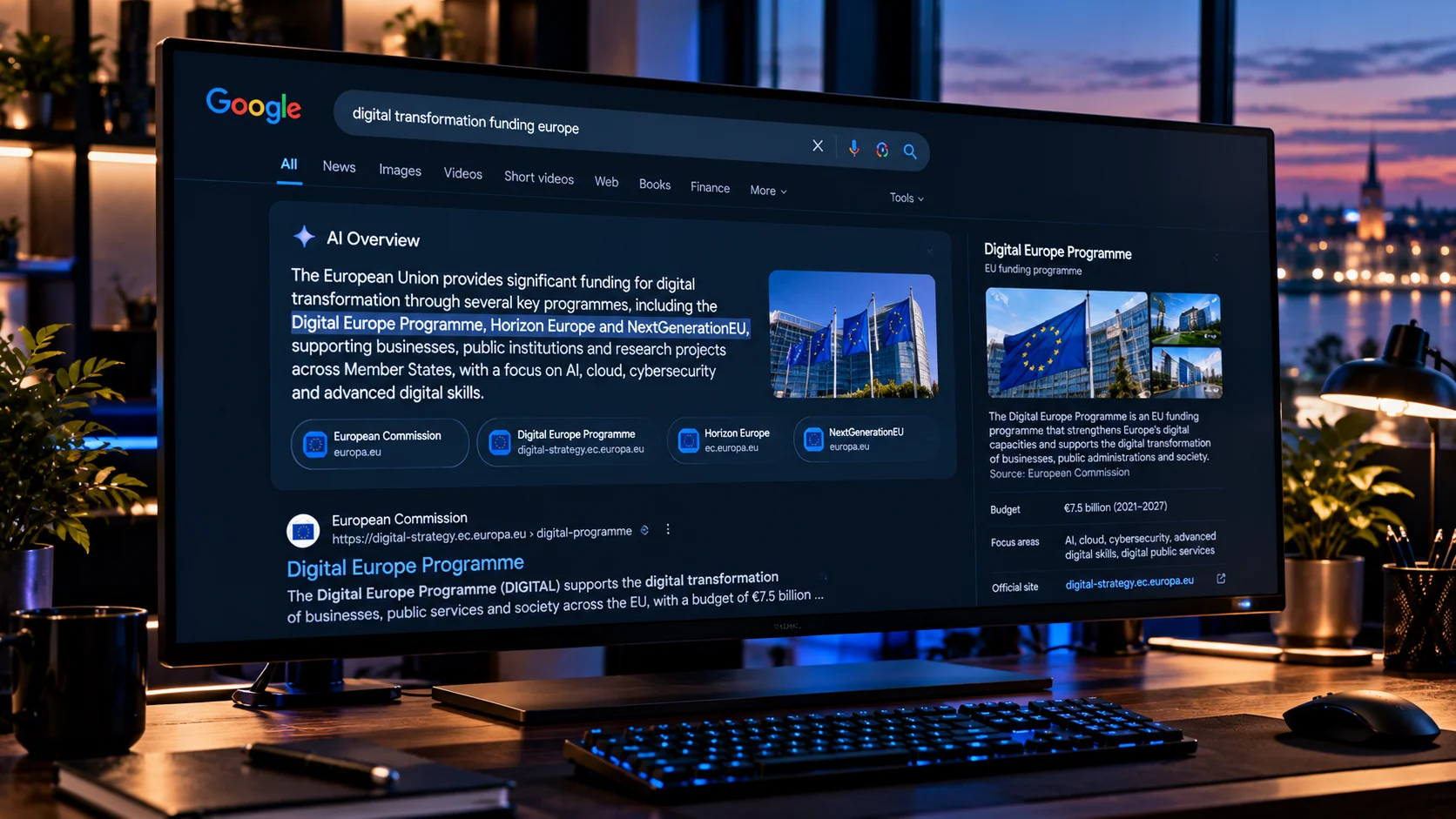
AI Overviews have been running in Google in Poland since 26 March 2025, and AI Mode since October 2025. In that time plenty of myths have piled up: that you “need to do GEO”, that uploading an llms.txt file is enough, that a site without schema.org will vanish from results. In 2026 Google published an official guide that debunks most of these theories, and research firms have gathered hard data on how many clicks are actually being lost.
Below we sort out the topic from the perspective of a hairdresser, a car workshop, a clinic or a software house in Szczecinek. Where the data comes from the US or is uncertain, we say so plainly.
In short
- According to Google there is no separate "SEO for AI": AI Overviews and AI Mode use the same ranking systems and index as regular results.
- Queries like "mechanic Szczecinek" still mostly show a map (Local Pack) - AI Overviews dominate informational questions such as "how much does it cost".
- When an AI Overview appears, people click regular results almost half as often (8% vs 15% according to Pew Research).
- The local foundation: Google Business Profile, reviews, consistent NAP data and a website with specifics (prices, process, photos, experience).
- Measure in Search Console (generative AI report, available to everyone since 31 August 2026) and in GA4 (traffic from chatgpt.com, perplexity.ai).
- Do not mass-produce AI-generated subpages - that falls under Google's scaled content abuse policy.
What AI Overviews and AI Mode are - and since when they work in Poland
AI Overviews (in Polish “Przeglądy od AI”) are a generated summary above the search results, with links to the pages it draws on. AI Mode is a separate, conversational search tab where you can ask complex questions and follow up. As Google describes in its documentation AI features and your website, both systems may use a technique called query fan-out: the model sends many related sub-queries in parallel and assembles an answer from various sources. That is why AI answers often include pages that are not in the top 3 for the main phrase.
AI Overviews in Poland
Google expands AI Overviews to 9 European countries, including Poland - for queries in Polish and English, for signed-in users aged 18+ (blog.google).
AI Mode in more than 40 new countries
Google announces AI Mode in more than 35 new languages and 40 countries, including Poland (blog.google). The Polish version reached users within a few days (benchmark.pl).
Google's official guide to AI optimisation
Search Central publishes Optimizing your website for generative AI features - with a myths section (llms.txt, chunking, artificial mentions).
AI report in Search Console
Google launches generative AI performance reports for some sites (Search Central Blog).
AI report for all sites
According to an update to the same post, the reports are now available to all sites worldwide.
How many clicks an AI Overview takes away - numbers from research
Most of the studies come from the US market and mainly measure informational queries. For a Polish local business they are more of an upper bound on the effect than an exact forecast, but the direction is unambiguous.
Pew Research Center analysed the browsing of 900 American adults in March 2025 - 68,879 searches, of which 18% displayed an AI summary. With an AI Overview, users clicked a traditional result in 8% of visits, without one in 15%. A link inside the summary itself was clicked in about 1% of visits, and the session ended on the results page in 26% of cases (vs 16% without AI). Source: Pew Research, 22 July 2025. Google disputes this study’s methodology.
Ahrefs compared 300,000 phrases based on aggregated Search Console data (desktop). For phrases with an AI Overview, the CTR of position 1 fell from 7.3% (December 2023) to 1.6% (December 2025); for informational phrases without an AI Overview, from 7.6% to 3.9% (Ahrefs, February 2026). An important takeaway: CTR is falling even where there is no AI, so not all of the loss can be attributed to AI Overviews.
Two more viewpoints. Seer Interactive (September 2025 update) shows that brands cited in an AI Overview have a 35% higher organic CTR (0.70% vs 0.52%) and a 91% higher ad CTR than brands that are not cited - though the authors stress that this is correlation, not proof of causation (Seer Interactive). BrightEdge, one year after AI Overviews launched, reported impressions up by more than 49% and CTR down by nearly 30% (BrightEdge, May 2025). In practice: you are seen more often but clicked less often - and what matters is whether you are a source of the answer.
Which local queries show an AI Overview and which show a map
This is the most important part for a service business. Whitespark manually checked 540 queries in three US cities and six industries (plumbers, lawyers, dentists, optometrists, clinics, real estate agents). Result: for strictly local queries an AI Overview appeared in 15% of cases and a Local Pack in 93%. For informational questions the proportions reversed: 92% AI Overview, 6% map. For mixed queries - 97% AI Overview and 17% map (Whitespark, May 2025). The author notes that the sample is small and that results may differ in smaller towns - Szczecinek is exactly such a case, so check your own phrases manually.
| Query type (example) | What the user usually sees | What to do |
|---|---|---|
| Service + city: “mechanic Szczecinek”, “hairdresser near me” | Local Pack with a map, ratings, phone number; AI Overview rarely | Complete Google Business Profile, correct primary category, reviews, photos, opening hours |
| Informational: “how much does a timing belt replacement cost”, “does an implant hurt” | AI Overview with links to sources | A page with specifics: price ranges, service duration, process, your own experience |
| Mixed: “good dentist for implants Szczecinek” | AI Overview + sometimes a map | A service page with experience, reviews that describe the service, consistency between website and listing |
| Brand: “company name reviews”, “company name opening hours” | Business panel from Maps, reviews, often an AI summary | Replies to reviews, up-to-date hours (including holidays), the same data everywhere |
| Conversation in AI Mode or ChatGPT: “recommend a software house in West Pomerania” | A list of companies with reasoning and links | Documented case studies, mentions in local media and directories, a clear “about us” page |
The takeaway for a clinic, workshop or salon: for the phrases that bring in phone calls, the fight is still happening in Maps, which we cover in more detail in the guide SEO for local businesses in 2026. AI Overviews hit how-to content hardest - that is, traffic that often did not call anyway.
How Google picks businesses for Maps - and what it feeds the AI
In the Business Profile help Google lists three local ranking factors:
- Relevance - how well a profile matches the query. Hence the importance of the primary category, services and description.
- Distance - how far the business is from the searcher (or from the location in the query).
- Prominence - how well known the business is, including online: links, articles, number of reviews and ratings. Google states plainly that more reviews and positive ratings can help local ranking.
The same source says: you cannot request or pay for a better local ranking. If someone is selling a “guaranteed spot in AI Overviews”, they are selling something that does not exist. In its guide to AI optimisation Google also warns that no third-party tool has access to its internal ranking systems.
That same guide confirms that a Google Business Profile helps you be visible both in AI answers and in regular results. AI Overviews work on a retrieval-augmented generation basis: the model retrieves pages from the index through the standard ranking systems and builds an answer from them. There is no separate “AI database” - there is the index, Maps and your reputation online.
Free visibility review
We will check how your business looks in Maps, AI Overviews and AI Mode
We will go through 10-15 of your key phrases, your Business Profile and your website - you will get a list of concrete fixes, no subscription.
Book a call+48 731 377 999How to become a cited source in AI Overviews and AI Mode
Google puts it in one sentence: there are no additional requirements to appear in AI Overviews or AI Mode, other than that the page is indexed and can be shown with a snippet. From Google’s perspective, optimising for generative AI is “still SEO”. What that means in practice for a local business:
Content that cannot be copied from other sites
Google’s guide talks about non-commodity content. A generic “7 tips” is commodity content; a case description from your own practice is not. For a workshop in Szczecinek that might be “How much DPF repairs actually cost across the 15 cars we handled this year” instead of the generic “What is a DPF”. For a clinic - a description of what the first visit with you looks like, how long it takes and what to prepare. An AI Overview assembles its answer from different sources, so it picks those that bring something new.
Specifics: prices, time, process, photos
“From-to” price ranges, turnaround times, process steps, photos of real projects. This is not a “hack for AI” - it is simply the information customers are looking for. Google also recommends good photos and video, because AI features may display them alongside text. We show how to structure such a page for a specific industry in the article a website for a clinic, restaurant and workshop, and you will find sample price ranges in our pricing.
Technology: indexing, speed, accessibility
The site must be crawlable and indexed, and the content visible in HTML (JavaScript is processed, but must not be blocked). Google recommends semantic HTML in part because it helps screen readers - the same principles are behind the accessibility requirements we describe in the article on website accessibility and the European Accessibility Act. In Search Console also check that the site has not been opted out of generative AI features - according to Google’s guide, that is a condition for being eligible to appear in AI Overviews.
Structured data: useful, but not magic
Google says structured data is not required for AI and there is no special schema.org markup for AI Overviews, but it is worth using as part of SEO - provided it matches the content visible on the page. For LocalBusiness, name and address are required; telephone, url, geo, openingHoursSpecification and priceRange, among others, are recommended. The review and aggregateRating properties apply to pages that collect reviews of other businesses - writing your own ratings into the code will not earn you stars in results.
Reputation beyond your site
Pew points out that the sources most often cited in AI summaries are Wikipedia, YouTube and Reddit. Locally, the equivalents are Google reviews, mentions in local media, industry directories and discussion groups. Google stresses, however, that buying inauthentic mentions does not help, because AI features rely on ranking and anti-spam systems at the same time.
llms.txt is not a Google standard
In its July 2026 guide Google states plainly: search does not use llms.txt files or other "AI files", so they neither help nor hurt visibility. The same applies to splitting content into micro-fragments ("chunking") and rewriting texts specifically for AI. You can maintain the file for other tools, but do not pay for its "implementation" as SEO.
Reviews, NAP and Business Profile - a foundation AI cannot replace
According to the BrightLocal Local Consumer Review Survey 2026, 97% of consumers use reviews when making a decision, and 41% read them “always” (29% a year earlier). The group of people who choose only businesses rated 4.5 and above is also growing. The data comes from the English-speaking market, but the trend matches what we see among clients in the region.
What to actually do:
- Ask for reviews systematically, for example with a link in an SMS after a visit or a QR code at the till. Encourage customers to describe the service (“clutch replaced in 2 days, as quoted”), because such text answers the questions of the next customers.
- Reply to every review, including negative ones - factually and without arguing.
- Keep your NAP consistent (name, address, phone): the same data on your website, in your Business Profile, in CEIDG (Poland’s business register), on Facebook and in industry directories. A mismatched phone number is a real problem for the customer, not just for the algorithm.
- Keep your hours up to date, especially holiday and vacation hours. AI and Maps show them directly.
Fake reviews are a legal risk, not just an SEO one
Google removes reviews that violate its policies, including purchased ones or ones written by employees. In Poland, since 1 January 2023, following the implementation of the Omnibus directive, commissioning fake reviews is an unfair market practice for which UOKiK (the Office of Competition and Consumer Protection) can impose a fine. Rewarding customers solely for positive reviews is also a bad idea.
What works and what does not in local SEO for AI
Works
- A complete Google Business Profile: category, services, photos, hours, description
- Regular, detailed reviews and owner replies
- Service pages with "from-to" prices, turnaround time and process
- Content from your own experience: case studies, photos, numbers from practice
- Consistent NAP data everywhere
- A fast, accessible, indexable site and correct structured data that matches the content
- Mentions in local media and at real events
Does not work (or hurts)
- An llms.txt file as "optimisation for Google"
- Hundreds of AI-generated "service + every village in the county" subpages
- Purchased reviews and artificial mentions
- Writing your own ratings into schema.org for stars
- Stuffing keywords into the business name in your listing
- Tools promising "guaranteed citation in AI"
- Writing texts "for AI" instead of for the customer
The point about mass-produced subpages is especially important. Google’s scaled content abuse policy explicitly lists “using generative AI tools to create many pages without adding value for users”. The AI guide adds that creating separate content for every query variation, or for fan-out queries, in order to manipulate AI answers also violates this policy. If you serve Koszalin, Czaplinek or Białogard, build a few subpages with real projects in those towns - as we describe on the service area page - instead of 80 clones that differ only in the name of the town.
A 30/60/90-day plan for a local business
Days 1-30: housekeeping and measurement
Verify your site in Search Console and GA4. Manually check 10-15 phrases (in an incognito window, from your phone): service + Szczecinek, price questions, your company name. Note where the map is and where the AI Overview is. Complete your Google Business Profile: primary category, services, hours, 10+ current photos. Make your NAP consistent on your website, in CEIDG, on Facebook and in directories.
Days 31-60: content and reviews
Rebuild 3-5 key service pages: price ranges, time, step-by-step process, project photos, an FAQ based on real customer questions. Implement LocalBusiness markup that matches the content. Start a steady process of asking for reviews (SMS/QR after the service) and reply to every one. Check your site's speed and accessibility on mobile.
Days 61-90: prominence and analysis
Publish 2-3 pieces of content from your own experience (case studies, comparisons, "what it really cost"). Earn 2-3 local mentions: a local portal, a partner, an event. Compare Search Console data (the AI report and the regular Performance report) and GA4 against your starting point. Repeat the manual phrase test and decide what is next - including whether to shift part of the budget to ads.
If you are wondering whether, with organic clicks falling, it is better to just pay for traffic, we have laid out the comparison of costs and results in the article Google Ads or SEO for a local business.
What to measure: Search Console, GA4 and traffic from AI chats
Search Console - the generative AI report. Available to all sites since 31 August 2026. It shows impressions in AI Overviews and AI Mode (and in AI features in Discover), URLs, countries, devices and dates, down to the hour (Search Central Blog). As of October 2026 the report does not show clicks or queries - Google says it will add metrics. AI traffic is also included in the regular Performance report (search type “Web”), so do not add the two reports together.
Search Console - the regular Performance report. Watch which pages have rising impressions and falling CTR. That is the typical picture of a page that appears next to an AI answer.
GA4 - traffic from AI chats. Create a custom “AI” channel group with a regular expression for sources such as chatgpt.com, perplexity.ai, gemini.google.com, copilot.microsoft.com. ChatGPT appends the parameter utm_source=chatgpt.com to many links, but not all, and some visits from mobile apps end up in “Direct”. In mid-October 2026 industry media described a possible change after which visits from ChatGPT may carry no UTM or referrer at all - OpenAI has not confirmed this. Treat these numbers as a lower bound.
Phone and form. For a local business the most important things are calls, messages and directions from Business Profile statistics, plus enquiries from the contact form. Also ask new customers how they heard about you.
A website that Google and AI understand
We build fast websites with correct structured data and measurement from day one
Search Console, GA4 with an AI channel and LocalBusiness markup that matches the content - standard in every project.
Websites in Szczecinek+48 731 377 999Local SEO checklist for AI Overviews
- Site verified in Google Search Console, sitemap submitted, key pages indexed
- The site is not opted out of generative AI features in Search Console, no accidental nosnippet / noindex
- Google Business Profile: correct primary category, services, description, hours (including holidays), current photos
- Business name in the listing without added keywords
- NAP identical on the website, in the Business Profile, CEIDG, social media and directories
- Every key service has its own page with "from-to" prices, turnaround time and process
- At least a few pieces of content from your own experience (case studies, photos, numbers)
- LocalBusiness structured data (name, address, telephone, url, geo, hours) matching the page content
- A steady process for asking for reviews and replying to every one
- A fast, readable mobile site with semantic HTML, accessible to screen readers
- GA4 with a custom channel for traffic from AI tools
- A monthly manual test of 10-15 phrases: map, AI Overview, AI Mode
What this means for businesses in Szczecinek and the region
AI Overviews are not the end of SEO, just a shift of emphasis. “Service + city” phrases are still won in Maps. How-to content is losing clicks, but it is what AI builds its answers from - if it adds something new. The most common mistake we see: paying for “GEO” in the form of files and mass-produced subpages while the listing is neglected and the website has no prices. The order should be the reverse: foundation first, then content from experience.
If your site needs a rebuild, see our offer of websites and websites for businesses from Szczecinek. If you want to automatically answer customer questions from your site and listing, check out AI agents for business.
Visibility in Maps and AI Overviews
Let us prepare your website and Business Profile for AI-powered search
We will review your phrases, listing and website, fix the structured data and set up measurement in Search Console and GA4. No promises of a "guaranteed spot in AI" - just a concrete list of changes and a 90-day plan.
Order a visibility reviewCall: +48 731 377 999