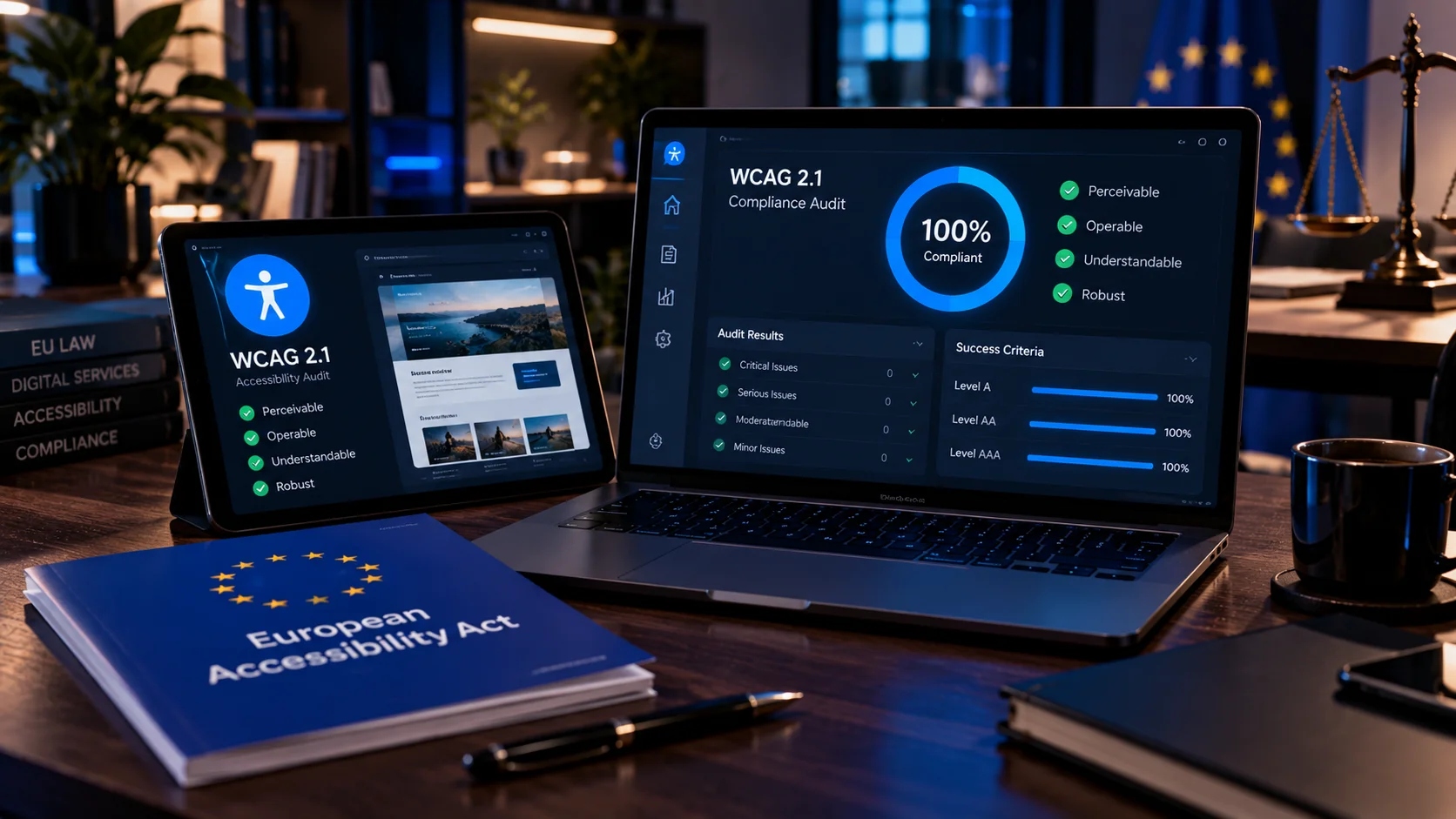
Since 28 June 2025, online stores, banks, carriers and telecom operators serving consumers have had to make their digital services accessible. The basis is the Act of 26 April 2024 on ensuring compliance with accessibility requirements for certain products and services by businesses (Journal of Laws 2024, item 731), known as the Polish Accessibility Act (PAD). It implements Directive (EU) 2019/882, the European Accessibility Act (EAA).
We updated this article in October 2026 based on the Act itself, the Ministry of Digital Affairs and PFRON websites, and the government’s official reply on fines imposed - no scare tactics, just the rules and the numbers.
In short
- The Act covers only services for consumers in 6 areas: e-commerce, retail banking, digital passenger transport services, telecommunications, e-books and access to audiovisual media.
- Micro-enterprises providing services are fully exempt (art. 4 point 1): fewer than 10 employees and up to EUR 2 million in turnover or balance sheet total.
- Stores are supervised by the Minister of Digital Affairs, and anyone can file a notification with the President of PFRON.
- Penalty: up to 10 times the average monthly wage (about PLN 89,000 in 2026), capped at 10% of turnover. As of August 2026 not a single one has been imposed.
- The biggest hidden risk is a customer complaint left unanswered for 30 days - it is then deemed accepted and you have 6 months to fulfil the request.
Does the EAA apply to me? A 5-step test
Before you order an audit, check whether the Act covers you at all. Go through the steps in order - the first “no” means the PAD obligations do not apply to you.
1. Do you serve consumers?
Art. 3 sec. 2 refers to services "offered or provided to consumers". A consumer is an individual buying outside any business activity. A wholesaler selling only to companies (B2B) is outside the Act.
2. Does the customer conclude a contract through your website or app?
An e-commerce service is a service provided at a distance through websites and mobile devices, by electronic means, at the individual request of a consumer "for the purpose of concluding a contract" (art. 5 point 32). A brochure site with a phone number and a contact form does not meet this condition.
3. Do you operate in one of the 6 areas?
E-commerce, retail banking, services accompanying air, rail, bus and waterborne transport (websites, apps, electronic tickets), telecommunications, access to audiovisual media services, e-books. The Ministry of Digital Affairs reads e-commerce broadly: it also covers insurance, health services, and online sales of clothing, cosmetics and medicines.
4. Are you a micro-enterprise?
If in at least one of the last two financial years you employed fewer than 10 people on an annual average and had net turnover (or a balance sheet total) of up to the equivalent of EUR 2 million - you are exempt. What counts is the annual average headcount, not the number of people in the company.
5. The result
Four "yes" answers and no micro status mean the Act covers you and you have the obligations described below. Micro: the rules do not bind you, but accessibility still pays off in business terms.
The definition of a micro-enterprise (art. 7 sec. 1 point 1 of the Entrepreneurs’ Law) is also quoted in the PFRON guidelines for businesses. Of the last two years, you need just one in which you fall within both thresholds. EUR 2 million is about PLN 8.5 million (the exchange rate varies, so convert at the rate applicable for the given year).
The micro exemption covers services, not products
If you manufacture, import or distribute products listed in art. 3 sec. 1 (computers, payment terminals, ATMs, e-book readers, smartphones used for telecommunications services), micro status does not exempt you from the product requirements. It only exempts you from part of the documentation (art. 21 sec. 9).
Covered or not - market examples
The most common questions we hear from companies in the region come down to a few typical situations. For three of them (marketplace, bookings, mixed model) the Act gives no direct answer, so we mark them as our interpretation.
Covered (if you are not micro)
- A B2C online store with a cart and payment, including on WooCommerce, Shoper or Shopify
- A mobile app in which the customer buys a product or service
- Online sales of insurance, medical services, cosmetics and medicines (examples from the Ministry of Digital Affairs)
- Online ticket sales by carriers, online banking, customer panels of telecom operators, e-book stores
- Interpretation: booking with online payment (hotel, campsite, workshops), because the customer concludes a contract through the website
Not covered
- Any company that meets the micro-enterprise definition (as regards services)
- B2B-only sales, e.g. a wholesale platform for companies with login by NIP (tax ID)
- A brochure website with no way to conclude a contract (service description, phone, map, contact form)
- Urban transport and municipal, county and provincial passenger services (art. 4 point 3), apart from interactive terminals
- Content that the company does not fund, create or control (art. 4 point 2 letter b)
- Offices, public schools, municipalities - a different act of 2019 applies to them
- Interpretation: listings on Allegro (Poland's largest marketplace) - the platform controls the purchase interface, but the seller is responsible for their own descriptions and photos
Do you sell in your own store and on a marketplace at the same time? Then the rules apply primarily to your own store, because you control its code, cart and payments. We write more about this choice in the article own store or Allegro for a company in the region.
The public sector falls under a different act
Do not confuse PAD with the Act of 4 April 2019 on the digital accessibility of websites and mobile applications of public entities. That one applies to offices, schools and other public entities, and it is the one that requires an “accessibility statement”. A private company is subject to PAD only in the areas described above.
Service provider obligations - table
If the test came out “yes”, the Act imposes specific obligations on you. We have collected the most important ones in the table. The “penalty” column shows whether art. 73 expressly provides a financial penalty for the violation.
| Obligation | Provision | What it means in practice | Penalty under art. 73 |
|---|---|---|---|
| Meet the service accessibility requirements | art. 12 and 18-19 | Website and app that are perceivable, operable, understandable and compatible; in e-commerce, accessible login, security and payments | yes |
| Carry out a conformity assessment of the service | art. 32 sec. 1 | A documented audit against the requirements (in practice EN 301 549 and WCAG) | yes |
| Publish accessibility information | art. 32 sec. 2 point 1 | In the terms and conditions or an equivalent document: a description of the service, information needed to use it and how the service meets the requirements | indirectly (art. 65) |
| Take corrective action in case of non-compliance | art. 32 sec. 2 point 5 | Fix errors instead of hiding them | indirectly |
| Notify the authority of non-compliance | art. 32 sec. 2 point 6 | Inform the Minister of Digital Affairs without delay (there is a template on gov.pl) | yes |
| Respond to the authority’s requests | art. 32 sec. 2 point 7 | Provide information within the deadline in the request, without misleading | yes |
| Handle consumer complaints | art. 35-37 | Reply within 30 days (exceptionally up to 60), otherwise the complaint is deemed accepted | no, but the consequences are binding |
| Document an exception | art. 21 | For a “disproportionate burden”: assessment documentation, kept for 5 years, repeated every 5 years and reported to the authority | indirectly |
| Provide accessible support | art. 22 | Technical support, helpline, chat and help centre provide information in an accessible way | indirectly |
Details of the information obligations are described on the Ministry of Digital Affairs page on information obligations under PAD. Important: the ministry speaks of information in the terms and conditions, not of the public-sector “accessibility statement”.
The “disproportionate burden” exception
Art. 21 allows a company to depart from a requirement that would call for a fundamental change to the service or would impose a disproportionate burden. This is not a loophole for “it is expensive”: you have to calculate the net costs against the costs and revenues of the service, document the assessment, report it to the authority and repeat it at least every 5 years. Anyone who received external funding for accessibility (e.g. a grant) cannot use the exception (art. 21 sec. 11).
Key EAA deadlines
The Act has been in force for over a year, but some deadlines are still ahead. The key dates:
Directive (EU) 2019/882 (EAA)
The EU adopts common accessibility requirements for products and services.
Publication of the Polish Act
The Act of 26 April 2024 is published in Journal of Laws 2024, item 731.
The rules start to apply
New services and products must meet the requirements. The Minister of Digital Affairs becomes the supervisory authority for e-commerce.
Zero fines in e-commerce and telecommunications
Reply of the Ministry of Digital Affairs to interpellation no. 18677: neither the Minister of Digital Affairs nor the President of UKE has imposed a fine under art. 73. UKE is carrying out inspections and monitoring fixes.
EN 301 549 v4.1.1 published
The new version of the standard moves to WCAG 2.2. Until it is published in the Official Journal of the EU, the reference point remains v3.2.1 (WCAG 2.1 AA).
First report of the President of PFRON
The first full report on how the system functions (art. 87).
End of the transitional period for services
Contracts concluded before 28.06.2025 and left unchanged expire, as does the option of using old, inaccessible products to provide services (art. 85).
The transitional period until 2030 does not protect a new website or a new purchase process. It applies to contracts concluded before 28 June 2025 and to products already in use. Art. 86 also excludes archived content: recordings and document files published before that date, and archived content that has not been edited since. PDFs of terms and conditions or price lists published after 28.06.2025 must already be accessible.
Inspections, complaints and fines - how it really works
The supervision system has three layers. The President of the PFRON Management Board coordinates the whole system and can carry out inspections personally. Sector market surveillance authorities conduct inspections in their areas. Customs authorities check imported products (art. 38).
| Area | Market surveillance authority |
|---|---|
| E-commerce | Minister of Digital Affairs |
| Retail banking | Financial Ombudsman |
| Telecommunications, audiovisual media, e-books, products (computers, terminals, readers) | President of UKE |
| Rail / air transport | President of UTK / President of ULC |
| Bus transport | Provincial road transport inspectors |
| Waterborne transport | Directors of maritime offices, Director of the Inland Navigation Office in Bydgoszcz |
UOKiK (the Office of Competition and Consumer Protection) is not a PAD supervisory authority. The Trade Inspection and UOKiK inspect stores under consumer law, but accessibility is enforced by the authorities listed above.
Two ways a problem can reach you
A consumer complaint to the company (art. 35-37). A customer can file a complaint in writing, orally (by phone or in person) or electronically if you have indicated such a channel. You have 30 days to reply, and in complicated cases up to 60 days, but you must inform the customer of the delay within the first deadline. If you do not reply on time, the complaint is deemed resolved in line with the request. You then have at most 6 months to fulfil it. A refusal must include factual and legal reasons and information about the possibility of notifying PFRON.
A notification to the President of PFRON (art. 67-68). Anyone can file it without showing a legal interest - including a competitor - also in Polish Sign Language. PFRON handles it within 30 days or forwards it to the competent authority. If the notification is justified, the authority conducts an inspection. The form and contact channels are described on the PFRON page on notifications.
Free preliminary check
We will check whether your store falls under the EAA and what needs fixing
In 30 minutes we will establish your company's status, walk through the purchase path with a keyboard and a screen reader, and point out the errors that could trigger a call to remedy.
Book a check+48 731 377 999From a call to remedy to a fine
An inspection does not end immediately with a penalty. After finding non-compliance, the authority calls for corrective action and sets a deadline for evidence of the fix, no longer than 120 days (art. 62 sec. 1 point 1). It can also ban the provision of the service by decision for up to 180 days. If you do not provide evidence, it opens administrative proceedings (art. 63). The decision may order a fix, ban the provision of the service or order that consumers be informed of the non-compliance (art. 65). A fine can also be imposed at that point.
Art. 73 provides for a fine of up to ten times the average monthly wage in the national economy for the previous year, but no more than 10% of the turnover of the preceding year. For 2025 GUS reported PLN 8,903.56 (data via ZUS, announcement of 9 February 2026), so the maximum in 2026 is PLN 89,035.60. The amount depends on the gravity of the violation, the number of inaccessible services and affected persons, and the money goes to the Accessibility Fund. A service provider can be fined separately for each of the five violations in art. 73 sec. 1 point 2: an inaccessible service, no conformity assessment, failure to notify the authority, no evidence of a fix within the deadline, and failure to provide information or providing false information.
State of enforcement as of October 2026
According to the Ministry of Digital Affairs' reply to interpellation no. 18677 of 3 August 2026, the Minister of Digital Affairs has not issued any fine decision because "there were no cases indicating a need to apply fines". UKE is at the stage of inspections and monitoring of fixes. We found no public PFRON statistics on the number of notifications. In France, organisations of people with disabilities sued large retail chains in 2025, including Auchan and Carrefour, over inaccessible online stores (industry reports, we did not verify the outcomes in court sources).
So the real risk in 2026 is not an immediate fine, but a customer complaint not handled within 30 days or a call to make fixes in the middle of the sales season.
Technical standard: EN 301 549 and WCAG 2.1 AA
The Act does not name WCAG. It speaks of perceivability, operability, understandability and compatibility (art. 12 sec. 2). A presumption of conformity is given by applying harmonised standards (art. 20). In its list of standards for e-commerce, the Ministry of Digital Affairs points to the standard EN 301 549 V3.2.1 (2021). In the part concerning websites it is based on WCAG 2.1 at levels A and AA. PFRON adopts the same in its guidelines.
In September 2026 EN 301 549 v4.1.1 was published, which adopts WCAG 2.2 as its reference point. AccessibleEU notes that until publication in the Official Journal of the EU, the binding reference remains v3.2.1. If you are building or rebuilding a store now, design for WCAG 2.2 AA from the start. New requirements include a minimum touch target size of 24 x 24 px (2.5.8), a visible focus not obscured by, for example, a sticky cookie bar (2.4.11), and accessible login without memory tests (3.3.8).
The scale of the problem: the WebAIM Million 2026 report automatically detected WCAG errors on 95.9% of the million most popular home pages, averaging 56 errors per page. The most common are low text contrast (83.9% of pages), missing alternative text (53.1%) and form fields without labels (51%).
WCAG 2.1 AA checklist for a store - top 15
This is not a full audit (WCAG 2.1 AA has 50 criteria), just the 15 points on which stores most often fail. Success criterion numbers are in parentheses.
- Text contrast of at least 4.5:1, for large text (18 pt or 14 pt bold and up) 3:1 - including prices, crossed-out sale prices and text on banners (1.4.3)
- Contrast of interface elements 3:1 - field borders, icons, checkbox state (1.4.11)
- Alternative text for product photos and icon buttons; decorative images with empty alt="" (1.1.1)
- Full keyboard operation - menu, filters, variant selection, cart, payment, with no traps in modal windows (2.1.1, 2.1.2)
- Visible focus - no outline: none without a replacement; logical Tab order (2.4.7, 2.4.3)
- Field labels associated through label, not just a placeholder; autocomplete for name, address, e-mail, phone (3.3.2, 1.3.5)
- Error messages in text, next to the specific field, with a hint on how to fix it, not just a red border (3.3.1, 3.3.3, 1.4.1)
- Name, role, value of custom components (sliders, accordions, variant switches) - native HTML or correct ARIA (4.1.2)
- Status messages such as "Added to cart" and changes in the number of results announced to the screen reader via aria-live (4.1.3)
- Structure - one H1, logical H2/H3, lists as lists, size tables with headers (1.3.1)
- Zoom and reflow - text at 200% without loss of content, no horizontal scrolling at 320 px width (1.4.4, 1.4.10)
- Descriptive links and buttons - not "See more" ten times; a cart icon with an accessible name (2.4.4)
- Page language lang="pl" and page titles that describe the content (3.1.1, 2.4.2)
- CAPTCHA and time limits - an alternative to image CAPTCHA, the ability to extend the cart and payment session (1.1.1, 2.2.1)
- Multimedia and documents - captions for product videos, audio transcripts, accessible PDFs of terms and instructions with tags and reading order (1.2.2, 1.2.1)
Watch out for third-party elements: payment gateways, chats, cookie banners, instalment calculators. Art. 18 requires accessible identification, security and payments in e-commerce, so an inaccessible operator widget is still your problem towards the customer - require compliance in your contract with the provider.
Accessibility overlays do not settle the matter
Plugins with a little-person icon that promise compliance "with one script" do not fix missing labels, keyboard traps or inaccessible payments. Neither the Act nor the EN 301 549 standard recognises them as meeting the requirements. Fixes have to be made in the code and the content.
How to test: tools and their limits
Automated tools are fast and free, but they catch only part of the problems. Deque, the maker of the axe engine, estimated in a 2021 study of about 300,000 issues from over 2,000 audits that automated tests detect about 57% of problems. The rest need a human: whether alt text makes sense, focus order, how understandable messages are, how the page works with a screen reader.
| Tool | Type | What it is for |
|---|---|---|
| axe DevTools | browser extension, free basic version | Quick scan of a single page, good error descriptions |
| Lighthouse (Chrome DevTools) | built into Chrome | A 0-100 score based on axe-core rules; good for a start, does not replace an audit |
| WAVE (WebAIM) | extension / web service | Visual marking of errors on the page: contrast, alt, structure |
| NVDA | free screen reader (Windows) | Going through the purchase path the way a blind person does |
| VoiceOver | screen reader built into macOS and iOS | Testing the store on an iPhone - key when mobile traffic is high |
| Keyboard (Tab, Shift+Tab, Enter, Space, Esc) | no installation | The simplest test: can you buy a product without a mouse |
The minimum set is 5 paths: home page, product list with filters, product page, cart with payment, customer account - each with an automated tool, a keyboard and a screen reader. The Lighthouse documentation explicitly separates the audits that must be checked manually and do not affect the score, so 100/100 does not mean compliance.
30-day implementation plan
This is a realistic schedule for an average store on an off-the-shelf platform or custom code. A large site with a mobile app needs more time, but the order stays the same.
Days 1-3: legal status and scope
Check headcount and turnover for the last two years (micro status). Make a list of B2C services: store, app, customer panel, bookings. Name the person responsible for complaints.
Days 4-10: audit
An automated tool (axe, WAVE, Lighthouse) on the 5 key paths, then a test with the keyboard and the NVDA or VoiceOver screen reader. The result is a prioritised list of errors: blocking a purchase, making it harder, cosmetic.
Days 11-22: critical fixes
First everything that blocks a purchase: form labels and errors, keyboard operation of the cart and payment, focus, contrast of buttons and prices, product alt text. Report their problems to your payment and chat providers.
Days 23-26: documents and procedures
Add accessibility information to the terms and conditions (art. 32). Launch a complaints channel (e-mail, phone) with a 30-day deadline process. Write down the conformity assessment documentation, and if non-compliance remains, notify the Minister of Digital Affairs using the gov.pl template.
Days 27-30: retest and process
Repeat the tests on the same paths. Add an automated scan to the change publishing process and set a quarterly review of content: new banners, PDFs, videos.
Audit and fixes in one place
We will take your store through this plan in 30 days
We run the WCAG audit, fix the code on WooCommerce, Shoper and custom solutions, and prepare the terms and conditions wording and the complaints procedure.
Ask about an accessibility audit+48 731 377 999How much an accessibility audit and implementation cost
There is no official price list, and audit firms rarely publish rates. The ranges below are our market estimate for October 2026, not an offer. The price depends mainly on the number of unique templates (not subpages), the number of paths to test and whether a mobile app is involved.
| Scope | Approximate net cost | Time |
|---|---|---|
| Preliminary automated scan + short report | PLN 0-1,500 | 1-2 days |
| Expert WCAG 2.1 AA audit of a store (8-15 templates, 5 paths) | PLN 3,000-9,000 | 1-2 weeks |
| Audit with tests involving people with disabilities | PLN 8,000 to 20,000 | 2-4 weeks |
| Fixes in an existing store | PLN 3,000-25,000, depending on template and plugins | 2-8 weeks |
| New store designed for WCAG 2.2 AA from the start | about 10-20% more than the same store without accessibility requirements | same as the whole project |
| Maintenance (retests, review of new content) | from a few hundred PLN per month | ongoing |
The most expensive are stores on heavily modified themes with dozens of plugins, the cheapest is a new project in which accessibility is simply correct HTML. Indicative prices of websites and stores are in our price list, and post-launch care is covered by IT support.
Accessibility, Google and SEO - facts without exaggeration
“An accessible site ranks higher in Google” is an oversimplification:
- No direct signal. Google does not list accessibility or the Lighthouse Accessibility score among ranking signals. Core Web Vitals measure performance and stability: LCP up to 2.5 s, INP up to 200 ms, CLS up to 0.1. They do not measure accessibility.
- Shared foundations. Descriptive alt text helps in image search. Logical headings, descriptive links and valid HTML make it easier for crawlers to understand the content. Google’s guidelines for site creators recommend the same.
- Conversion. Readable forms, clear errors and large buttons reduce cart abandonment for all customers, not only people with disabilities. According to preliminary data from the 2021 national census (NSP 2021) by GUS, about 5.4 million people with disabilities live in Poland (14.3% of the population), and to that you can add seniors and people with weaker eyesight.
- AI and shopping assistants. Search engines with AI answers and shopping agents read a page from its code, much like a screen reader. Clean semantics help here too. We write about this in the article on Google AI Overviews and local SEO.
Accessibility is part of website quality, alongside performance and security - more in the article business website in 2026.
What to do now - summary for companies in the region
A store in Szczecinek or Koszalin with 4 employees and PLN 3 million in turnover is a micro-enterprise: the Act does not apply to it, and it improves accessibility only for its customers. A store with 15 employees, a carrier selling tickets online or a travel agency with online payment are subject to the rules and should have a conformity assessment, wording in the terms and conditions and a complaints procedure.
Planning a new store? Put WCAG 2.2 AA in the specification from day one - we write about choosing a platform in the guide online store in Szczecinek in 2026. Already have a live site? Start with a 15-minute keyboard test on the purchase path. Accessibility is standard in our websites.
Digital accessibility without scare tactics
Check whether the EAA applies to you, and fix what blocks purchases
Mikamait from Szczecinek: verification of your company's status, WCAG 2.1/2.2 AA audit, code fixes, wording for the terms and conditions and a complaints procedure. We reply within 24 hours.
Order an accessibility checkCall: +48 731 377 999